
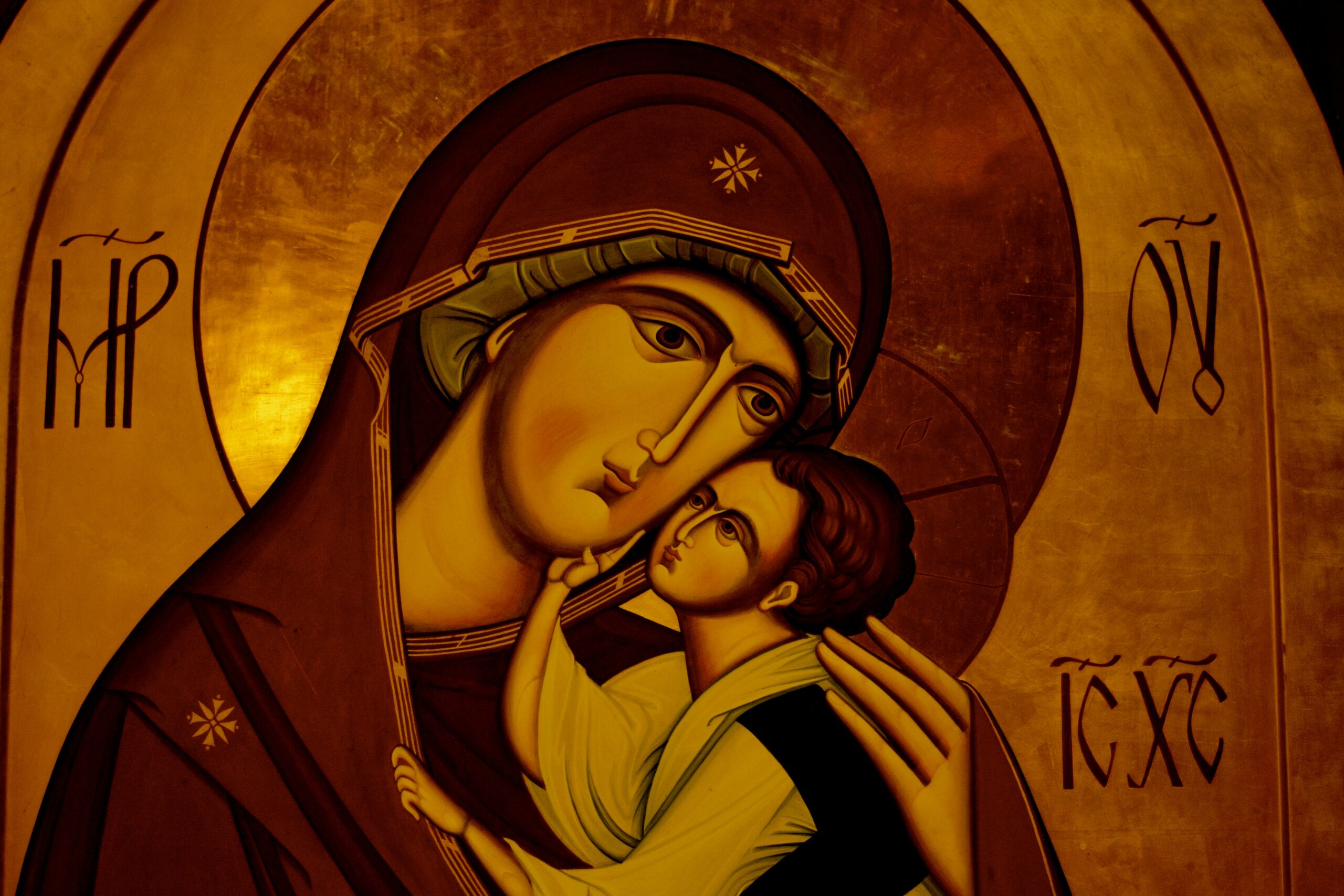
An Interview with Fr. Jeremiah Shryock, CFR
A discussion with a friend:
In college I would often have theological discussions with my roommate who wasn’t Catholic. And it would often times come around to Mary. Then one day he said, “Well, I don’t need Mary.” I paused, and after a few minutes found myself responding, “Well, maybe you don’t. But Jesus did. And aren’t we supposed to imitate Him?” The reason we want Mary in our life is to imitate Jesus. Jesus gave Himself to Mary. He put Himself in her arms to be cared for and to be nurtured by her. And so if we are to be true Christians, we want to follow Him. We should love what God loves. What does God love? Certainly His mother.
Why is a relationship with Mary important for a life of intimacy with God?
It’s important because wherever Mary is, Jesus is there. No one knows a son better than His mother. Mary carried Jesus in her womb for nine months, and she was by His side for 33 years. She heard Jesus say things that no one else heard. She watched Jesus do things that no one else saw. She lived her entire life with Him, in Him, and through Him. Mary had the greatest intimacy with Jesus. There is no one who knows or loves Him more than His mother.
As a spiritual director, what do you see with those you direct who have found peace in difficult times?
If somebody were to ask me what happened to each one of these people, I would simply say, “Mary is what happened to them.” Amid their confusion, pain, and brokenness, by turning more deeply to her, they found in her that loving, accepting, and nurturing mother whose presence, in a very real way, dried their tears. Once those tears were dry, Mary did what she always does. She took them by the hand in the darkness and led them back to the presence of her Son, “the light of the world” (John 8:12).
Isn’t it true that we often want to hide our neediness? What does Mary’s way reveal?
There is nothing that repulses us more than our neediness and poverty. Over the years I have been blessed to accompany a few people who are in AA. I have nothing but respect and admiration both for the program itself and the people who are part of it. I once attended an AA meeting with a friend of mine who was too afraid to go by himself. After the meeting, my friend asked me what I thought, and I responded enthusiastically, “It was so refreshing.” Throughout the meeting someone would stand up and basically say, “Hello, I’m Bob, and my life is a mess …” then he would sit down and a few moments later someone else would stand up and say, “Hello, I’m Kelly, and my life is a mess …” After hearing this for an hour, I remember thinking to myself that this is the most honest conversation I have heard in a very long time. I thought it was so refreshing because these people were not trying to hide their poverty and neediness. And in this honesty, they encounter God, the only One that can fulfill that neediness. Unfortunately, most of us do not speak like this. Rather we are like, “Hello, I’m Bob, and I’m amazing. I make this much money; I have this many degrees, and I drive this kind of car. And, by the way, my family is perfect, and the school where my children go is perfect.” We feel the need to impress others and to prove to others that we are in control of our lives. In short, we want people to believe that we are not in need of anything. However, being “needy” is a part of who we are, regardless of how organized our psychological and emotional life is and no matter how much we may have convinced others that we are different. The truth never changes: we are in need. But it is in Mary’s Magnificat that she rejoices in her neediness. “I rejoice in God my Savior, for He has looked with favor on His lowly servant” (Luke 1:47-48). Mary sees her need for God as one of the reasons for God’s grace in her life. She sees her need for God as a bridge in which God comes to her. We see our neediness as a sign that God doesn’t love us. But in Mary it’s the opposite. She sees her poverty as the greatest gift because it’s what attracts God to her.
How can Mary help us through anxiety?
Most of us do not live in reality most of the time. What do we live in? We live in our daydreams; we live in our fears, anxieties, memories, hurts, wounds, the tragedies in our life. Most of us are not tuned into reality as it is right now. And we are always asking the what-if’s. What if I get sick? What if I lose my job? What if this person rejects me? What-if’s are possible, but most of the time they are not. They are most often based in fear or are coming out of anxiety, or doubt, or lack of trust. These are all normal human experiences, but we have to place them in the right perspective. Jesus reminds us, “Do not be anxious about your life, what you shall eat or what you shall drink, nor about your body, what you shall put on” (Matthew 6:25). Why? Because “Your heavenly Father knows that you need them all” (Matthew 6:32). Despite all the what-if’s that could have occurred in Mary’s life, she always rooted herself in the truth that the presence of God is reality. Even if all of these what-if’s came true (and the vast majority of them do not), they could not take away God’s presence. He is with us, and He infinitely loves each one of us. With such confidence and assurance in God’s love and presence, Mary can listen deeply to her life and not get swept away in an emotional frenzy as to what could happen.
We often are never satisfied with our life. What did life with Jesus, Who was God, look like?
When I graduated high school, I spent two years traveling throughout the country, because I believed that truth and the meaning of my life was somewhere “out there.” I was convinced that by traveling I would discover what I was desperately looking for. Even though I enjoyed that time and considered it a great blessing, it wasn’t until I returned home and began to live a more interior life with God that I discovered more deeply truth and the meaning of life. In those two years of traveling, I drove approximately ten thousand miles in my car, and when I returned home I was basically the same person, with the same unanswered questions and the same deep yearning in my heart. After three months of being at home and beginning to pray daily, attend Mass, and read the Bible, I received more insight to my questions in that time than during my two previous years on the road. The truth, I discovered, was not “out there,” but interior. As Jesus says, “The kingdom of God is within you” (Luke 17:21). For many people, ordinary life is very difficult to accept. We expect life to be like a movie — filled with excitement. When we begin to discover that life is nothing like the way it is portrayed in movies, books, and even social media, this can and often does challenge our faith. It can make us question who God is and cause us to doubt God’s presence in our life. Also, it can force us to reexamine our ideas about who we think we are and what the meaning of our life is. Because ordinary life does this, it is so good for us. This ordinary life will be, in fact, how Mary and Jesus will spend most of their life. Many biblical scholars suggest that the Holy Family spent about three years in Egypt, which would make Jesus three or four years old as they return to Nazareth. His public ministry lasted only three years, and having died at the age of 33, Jesus then spent about 25 years of his life living an ordinary life with Mary.
What would Mary say if she was our spiritual director? What would that be like?
This is the way I imagine it for myself: I am sitting with Mary in a room overlooking a lake. On the wall is a simple crucifix, and we are seated on two simple wooden chairs. I begin by expressing to her all my fears, my desires, my hopes, my wounds, my weaknesses, etc. All the while she is listening very attentively and with deep compassion in her eyes. When I am finished, we sit there together in silence and gaze out the window at the lake. After a few moments she looks me in the eye and says, “My son, God is trustworthy. Don’t be afraid to say yes to Him. Don’t wait for consolation; don’t wait for understanding. Don’t wait for everyone to agree with you, and don’t wait until everything in your life is ‘perfect,’ because it never will be. Say yes to Him today, and then tomorrow, and again every day, because He is trustworthy, and He is faithful.” I think that is what she would say to each one of us.
Fr. Jeremiah Myriam Shryock, CFR is a Franciscan Friar of the Renewal. He is a spiritual director for the Sisters of Life. Currently he is living as a hermit at the Monastery of Bethlehem in Livingston Manor, NY where he serves as a chaplain to the Monastic Sisters there. He is the author of the book: Amid Passing Things: Life, prayer, and relationship with God, and he has just finished writing a book on Mary called Mary and the Interior Life, which will be released in May 2024.
Originally printed in IMPRINT Magazine Spring 2023.




